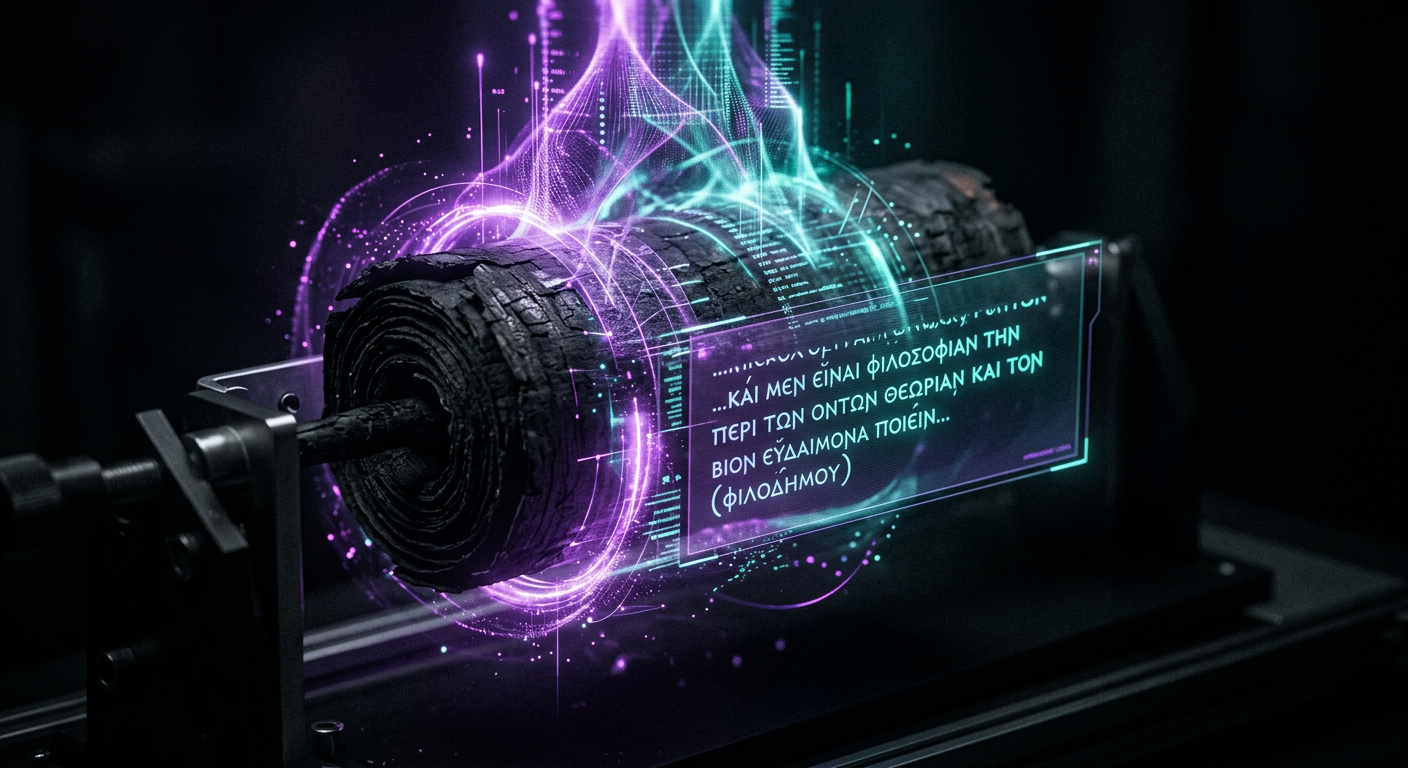
A library that was lost for 2,000 years — and the AI that reads it faster than any scholar can
I have a soft spot for things that were hidden and then, suddenly, are not. It’s the same pull that drew me to Göbekli Tepe and Karahan Tepe — those impossibly old megaliths that quietly rewrite the timeline of human history. So when I read that the Vesuvius Challenge has now handed out over $1.8 million to teams reading the charred Herculaneum scrolls, I stopped scrolling. This is exactly the kind of story I keep coming back to: technology that reveals what was buried, without destroying it in the process.
Here’s the part that still gets me. In 2024, the first prize — a cool million dollars — was awarded for reading a single word. One word, “πορφύρας”, the Greek for “purple”, pulled out of a scroll that looks like a lump of charcoal. Two years later, the counter sits at $1.837 million, and the teams are no longer reading words. They’re reading whole passages of Epicurean philosophy that were considered lost forever.
Why this matters more than the headline
The obvious story is “AI can read ancient scrolls.” That’s the news, and it’s true. But the deeper thing — the thing I actually think about in the evening when the house is quiet — is the pace of it. A human scholar spends a lifetime on a handful of fragments. The AI pipeline — segmentation, virtual unwrapping, machine learning — reads a library in a tempo no human can match. And that changes the meaning of the discovery itself.
It’s the same pattern I keep noticing in my own work with AI agents. It’s not that the AI does something a human couldn’t do. It’s that it does the boring, repetitive part — the scanning, the enumerating, the crawling — at a speed that makes the impossible merely slow. The Herculaneum scrolls are the most beautiful version of that: the first time in history a lost library is being recovered without damaging the physical artifacts. The Vesuvius Challenge literally requires the scrolls to stay intact.
And there’s a second layer I can’t shake. The philosophy coming back to life is Epicurean — a school that was itself suppressed in antiquity. So the “rediscovery” is double-layered: we’re not just reading old text, we’re reading text that was deliberately pushed out of the record. AI is un-hiding something that was hidden twice.
The question I keep turning over
So here’s the question I’d love to hear your take on. When an AI reads a library at a pace no human scholar can keep up with, does the meaning of what it finds change? We’re used to discovery being slow — a lifetime of patience for a single insight. What happens to our relationship with the past when the past can be read in a weekend?
I don’t have a clean answer. But I suspect it’s the same answer I keep landing on with my own agents: the AI doesn’t replace the human. It just does the part we’re too slow for, and leaves us the part that actually matters — deciding what it all means. Drop a comment below. I’m genuinely curious how you read this one.
Wat vond je van dit bericht?
